The Responsive City: AI as an Engine for Civic Reparations and Community Resilience
Abstract
The concept of the “Smart City” has long been dominated by visions of efficiency, surveillance, and optimization. However, a new paradigm is emerging: the “Responsive City,” where Artificial Intelligence (AI) is deployed not to monitor citizens, but to serve them. This article explores the transformative potential of Civic AI to dismantle the “time tax” of bureaucracy, reverse historical inequities in urban planning (“algorithmic reparations”), and radically democratize municipal budgeting. By shifting the focus from control to care, AI can become a powerful tool for civic justice and community resilience.
Introduction: From “Smart” to “Responsive”
For decades, urban technology has promised a frictionless future. Yet, for marginalized communities, “Smart City” initiatives often translate to increased policing and data extraction without a commensurate improvement in quality of life. The “Responsive City” framework flips this script. It posits that the true measure of a city’s intelligence is its ability to listen to its most vulnerable residents and respond with speed, dignity, and equity.
Dismantling the “Time Tax”: AI as a Civic Advocate
Low-income and minority communities face a disproportionate “time tax”—the administrative burden of navigating complex government systems to access basic rights like housing, food assistance, and healthcare.
- The Theory: Researchers Herd and Moynihan (University of Michigan) define these administrative burdens as a primary mechanism of inequality, discouraging eligible individuals from accessing the social safety net.
- The Solution: AI-driven service agents can act as 24/7 civic advocates. A compelling case study from the OECD highlights how the Spanish region of Catalonia deployed an AI system to automate eligibility assessments for energy poverty assistance. Instead of forcing struggling families to prove their poverty through endless paperwork, the system proactively identified eligible households and streamlined their support. This is AI as an engine of empathy, removing the friction that keeps people poor.
Algorithmic Reparations: Reversing the Map of Exclusion
Historical redlining—the systematic denial of services to Black neighborhoods—has left deep scars on American cities, visible in “transit deserts,” “food deserts,” and infrastructure decay.
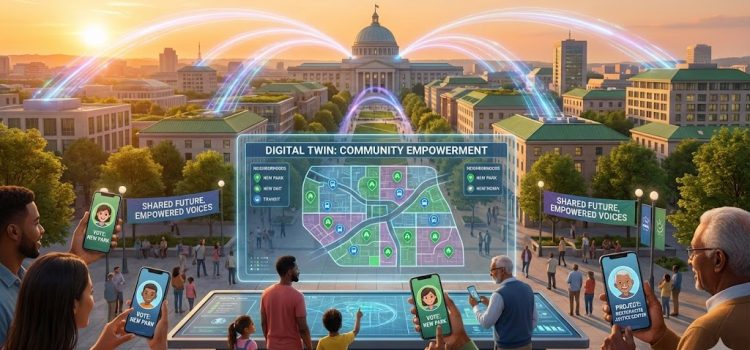
- The Concept: “Algorithmic Reparations” involves using AI simulations and “Digital Twins” to model the inverse of redlining. Instead of optimizing for peak commercial traffic, urban planners can train algorithms to prioritize infrastructure investments in historically underfunded zip codes.
- In Practice: Platforms like UrbanistAI and initiatives championed by the UNDP are enabling “participatory urban planning,” where residents use Generative AI to visualize changes in their own neighborhoods. This allows communities to see—and advocate for—green spaces, clinics, and transit hubs before a single brick is laid, ensuring development serves the community rather than displacing it.
Democratizing the Budget: The AI Town Hall
Participatory budgeting—where residents vote on how to spend a portion of the city’s funds—is the gold standard of civic engagement. However, analyzing thousands of handwritten notes, voice memos, and emails from a diverse populace is a logistical nightmare, often leading to the loudest voices drowning out the rest.
- The Innovation: A recent study (arXiv, 2025) analyzes how Generative AI can synthesize vast amounts of unstructured citizen feedback during participatory budgeting cycles. By clustering themes and identifying sentiment across diverse languages and dialects, AI ensures that a suggestion from a single working mother in a town hall carries as much weight as a polished proposal from a developer. This effectively scales democracy, allowing thousands of residents to co-author the city’s future.
Conclusion: Building Trust Through Technology
The transition to a Responsive City requires more than just better code; it requires a fundamental shift in governance. We must move from “designing for” communities to “designing with” them. If we can harness AI to slash the time tax, intentionally invest in neglected neighborhoods, and amplify the voices of the unheard, we can build cities that are not just smart, but just.
References
- Herd, P., & Moynihan, D. P. (2018). Administrative Burden: Policymaking by Other Means. Russell Sage Foundation. (See also: University of Michigan Ford School of Public Policy, “A framework to reduce administrative burdens”, 2025).
- OECD (2024). Effective use of AI in Social Security: Harnessing Artificial Intelligence in Social Security. Retrieved from https://www.oecd.org/
- arXiv (September 23, 2025). Generative AI as a Catalyst for Democratic Innovation: Enhancing Citizen Engagement in Participatory Budgeting. Retrieved from https://arxiv.org/html/2509.19497v1
- United Nations Development Programme (UNDP). Bringing Communities Together Through AI-Driven Urban Planning. Retrieved from https://www.undp.org/
- Autodesk. Equitable urbanism: AI advances city planning and resource allocation. Retrieved from https://www.autodesk.com/