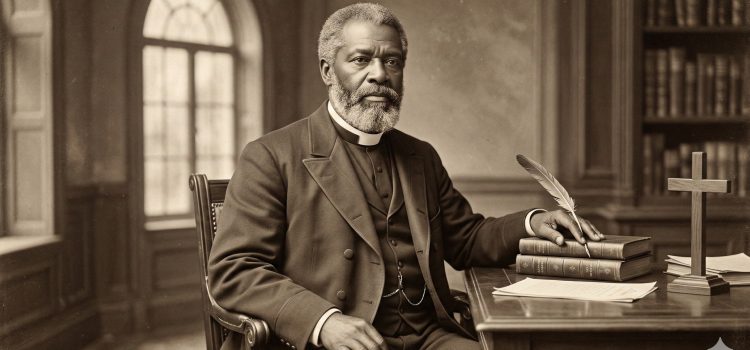

Bishop John Jamison Moore: A Multifaceted Leader of the AME Zion Church
A towering figure whose influence shaped the spiritual, intellectual, and cultural heart of Black communities across America.
Bishop John Jamison Moore (1818-1893) wasn’t just a leader; he was a whole movement wrapped in one dynamic individual, born into the chains of slavery in West Virginia. His early life was a testament to the indomitable spirit of his people, as he and his mother broke free, escaping to Philadelphia at the tender age of 15. This journey to freedom ignited a fire within him, shaping the man who would become a true pioneer and pillar of the African Methodist Episcopal Zion Church. Moore’s influence stretched far and wide, touching the spiritual, intellectual, and cultural heart of Black communities. He wore many hats with grace and power: a bishop, a compelling journalist, a meticulous church historian, and a dedicated educator. His keen intellect and commanding presence on the pulpit earned him a rightful place among the greatest preachers of his era. Folks would tell tales of his ability to recite scripture from memory with an eloquence that could stir the soul and awaken the spirit.
He wore many hats with grace and power: a bishop, a compelling journalist, a meticulous church historian, and a dedicated educator.
From Philadelphia Pulpits to the Golden Gate: A Vision for the West
After finding his voice and purpose as a prominent preacher in the AME Zion Church in Philadelphia, Bishop Moore’s vision extended beyond the familiar. In 1852, with a pioneering spirit echoing the brave souls who sought new horizons, he moved to San Francisco. His mission was clear: to plant the seeds of faith and freedom on the Pacific Coast. In August of that year, he founded the first AME Zion Church in San Francisco, a monumental achievement that established a spiritual beacon for Black communities far from the traditional centers of the church. Bishop B.J. Walls would later credit Moore with “Planting the core tenets of freedom, as practiced by his denomination, on the Pacific Coast.” This wasn’t just about building a church; it was about laying a foundation for self-determination and community empowerment in a new frontier.

A Champion for Education and Civil Rights: Building for Generations
Bishop Moore understood that true liberation wasn’t just spiritual; it was intellectual and social. Recognizing the systemic barriers faced by Black children, he became a fervent advocate for education. In May 1854, alongside Rev. Thomas Marcus Decatur Ward, he co-founded the first private school for African-American children in San Francisco—the San Francisco Colored School. In a time when public schools shut their doors to Black youth, Moore stepped up, serving as its first teacher and principal. He believed in lifting as he climbed, ensuring that the next generation had the tools to thrive. But his advocacy didn’t stop there. In 1862, he launched and became the head editor of The Lunar Visitor newspaper. This wasn’t just any publication; it was a powerful voice for civil rights, tirelessly advocating for the development of educational, social, and political skills crucial for Black people to achieve full participation in American society. At a time when information was power, The Lunar Visitor stood as the only African-American magazine in the western part of the country, a testament to Moore’s unwavering commitment to enlightenment and justice.
The Bishop’s Mantle and Salisbury’s Sacred Ground
After years of groundbreaking work in California, Bishop Moore’s leadership and dedication were recognized on a broader scale. In the spring of 1868, he left California and was consecrated as a Bishop, a sacred calling that would bring him back eastward. He eventually settled in Salisbury, North Carolina, a place that would become profoundly intertwined with his personal and spiritual journey. It was here that he married Francis Moore, weaving a personal thread into the tapestry of his public life. For the folks in Salisbury, North Carolina, Bishop Moore was the visionary founder of the Western North Carolina Conference of the A.M.E. Zion Church. This wasn’t just about establishing another church; it was about creating a sacred space, a beacon of hope and empowerment for Black people seeking spiritual refuge and community during challenging times. His dedication to organizing and expanding the church’s reach was a testament to his belief in the power of faith to uplift and transform lives.
A Pen Guided by Purpose: Historian and Journalist
Beyond the pulpit, Bishop Moore understood the profound importance of documenting the journey and preserving the legacy of his people. His monumental work, History of the A. M. E. Zion Church in America, published in 1884, stands as a testament to his commitment to truth and historical accuracy. This wasn’t just a book; it was a comprehensive chronicle, meticulously tracing the church’s origins from its humble beginnings in 1796 in New York City, through its full separation from the white Methodist Episcopal Church in 1821, and up to its vibrant activities in his time. Moore didn’t just tell the story; he showed it, reprinting vital documents that charted every stage of the Church’s development, from its articles of incorporation to the minutes of contemporary conferences. This wasn’t merely an academic exercise; it was a sacred task, ensuring that the A.M.E. Zion Church’s rightful place within the broader tapestry of Christian history would be recognized and revered. As a journalist with The Lunar Visitor, he used his pen as a tool for enlightenment, advocacy, and connection, ensuring that the stories and struggles of his community were heard and amplified.
Salisbury’s Son: An Enduring Legacy
Bishop Moore’s profound impact is still felt deeply in Salisbury. His name graces Moore’s Chapel AME Zion Church, a living testament to his spirit, named in his honor by the reverent Joseph Torrence. It’s a place where his legacy continues to inspire generations, a constant reminder of the foundations he laid. When his earthly journey concluded on December 9, 1893, on a train ride home from a conference in Western North Carolina, Bishop Moore was laid to rest in Salisbury’s historic Dixonville Cemetery. This sacred ground holds the stories of many prominent Black residents, and his presence there further cements his indelible connection to the community he served so diligently. Bishop John Jamison Moore’s life was a powerful narrative, profoundly shaping the spiritual, intellectual, and social landscape of the Black community, leaving behind a legacy that continues to resonate with strength, grace, and unwavering purpose.