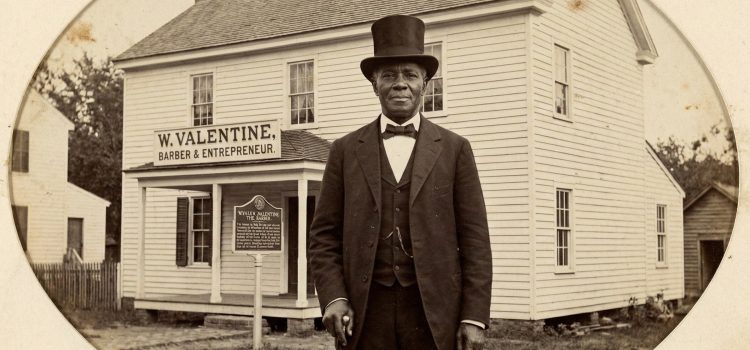

William Valentine: A Pillar of Early Black Entrepreneurship in Salisbury
A beacon of determination and self-sufficiency, carving out a respected place in a divided society.
Before the thunderous drums of the Civil War shook the very foundations of the nation, in the heart of Salisbury, North Carolina, stood a man whose life was a beacon of determination and self-sufficiency: William Valentine. In a time when the shackles of slavery bound millions, Valentine lived as a free Black man, carving out a respected place for himself and laying down roots in a society deeply divided by race. His story isn’t just one of personal success; it’s a testament to the indomitable spirit of Black entrepreneurship that flourished against overwhelming odds.
He managed to “secure the confidence and patronage of whites,” a remarkable feat documented by a local newspaper.
William Valentine was more than just a barber; he was an institution. As the only free Black barber in Salisbury, his shop wasn’t just a place for a trim and a shave; it was a hub, a place where news was exchanged, and perhaps, where dreams were quietly nurtured. His skill and character were such that he managed to “secure the confidence and patronage of whites,” a remarkable feat documented by a local newspaper upon his passing in 1893. This isn’t a small detail; it speaks volumes about the man’s integrity, his business acumen, and his ability to navigate the treacherous waters of racial prejudice with grace and professionalism.

His financial prowess was evident in his property ownership. In 1858, a pivotal year just before the war, Valentine purchased the William Valentine House at the estate sale of Horace Beard, located at 224 East Bank St., Salisbury. This wasn’t merely a house; it was a symbol of his economic stability and a cornerstone for his family and community. The very building that housed his barber shop, erected in the same year, stands today as Salisbury’s oldest extant commercial structure – a tangible link to his enduring legacy. Imagine the strength and foresight it took for a Black man to acquire and maintain such assets in a slaveholding state.
The location of his home held its own historical weight, situated across the tracks from the entrance gate of the Confederate States Military Prison. This proximity, while perhaps coincidental, underscores the stark realities of his existence and the volatile environment in which he thrived. Yet, through it all, Valentine not only survived but prospered.
William Valentine’s journey didn’t end with the war. He continued to build his life and contribute to the growing Black community. In 1886, he moved to Sableton, near Union Hill on the west side of town, indicating continued growth and perhaps a desire to be closer to burgeoning Black neighborhoods. When he transitioned on January 22, 1893, his passing marked the end of an era, but his influence reverberated for generations.
His life exemplified perseverance, economic self-sufficiency, and a quiet yet powerful defiance against the prevailing norms of his time. William Valentine didn’t just cut hair; he cultivated respect, built wealth, and in doing so, he laid a foundational stone for the burgeoning Black business community in Salisbury. His story reminds us that even in the darkest of times, Black excellence found a way to shine, illuminating paths for those who would follow. He truly was, and remains, a pillar of early Black entrepreneurship.